PORTUGAL TRIP PLANNING
How Many Days Do You Need in Portugal?
Seven days can make a very good Portugal trip. Ten days gives you choices. Two weeks gives the country room to open up.
Portugal looks manageable on a map.
That can be one of the biggest problems when planning a first trip.
Lisbon and Porto seem close enough to combine. Sintra is right outside Lisbon. The Douro Valley is near Porto. The Algarve is only another part of the same relatively small country.
Then perhaps you start thinking about Évora.
Or Madeira.
Before long, a vacation that originally sounded relaxed has become a sequence of trains, rental cars, hotel changes and travel days.
Portugal is compact enough that you can fit a surprising number of places into one trip.
That does not mean you should.
For most travelers, seven days is enough for a focused Portugal vacation, ten days creates substantially more flexibility, and two weeks allows you to experience several different sides of the country without making movement the organizing principle of the trip.
The better question is not:
How much of Portugal can I see?
It is:
How much Portugal can I experience well in the time I have?
The Short Answer
Choose 7 days if: You are comfortable concentrating on one part of Portugal and allowing nearby destinations to add variety.
Choose 10 days if: You want two major experiences—perhaps Lisbon and Porto, or one city combined with a region such as the Douro Valley, Alentejo or Algarve.
Choose 14 days if: You want to experience several different sides of Portugal while still giving the places you choose enough time to matter.
Choose 3 weeks if: You want genuine breadth and enough time to move through several regions without turning the trip into a race.
For a first visit, 10 to 14 days is an especially useful amount of time.
But a carefully designed seven-day trip can be better than a poorly designed two-week one.
Why Portugal Is Easy to Overplan
Portugal encourages ambitious itineraries.
Distances are relatively manageable.
Lisbon and Porto are connected by fast trains.
Sintra can be reached from Lisbon.
The Douro Valley can be reached from Porto.
Évora is accessible from Lisbon.
The Algarve can be connected to the rest of the country by road or rail.
Individually, none of these additions necessarily seems unreasonable.
The problem appears when you combine them.
Every new destination introduces more than transportation time.
There is packing.
Checking out.
Getting to the station or airport.
Picking up a rental car.
Finding your next hotel.
Waiting for check-in.
Learning another neighborhood.
And deciding what to do with luggage when arrival and departure times do not cooperate with hotel schedules.
None of those things will ruin a vacation.
But together they can quietly consume it.
That is why the number of places on your itinerary matters less than the number of transitions between them.
7 Days in Portugal — Choose Focus
A week is enough for an excellent Portugal vacation.
It is not enough for every Portugal vacation.
The distinction matters.
With seven days, we would generally choose one part of the country and explore it well.
Lisbon can anchor a trip that includes Sintra and perhaps another nearby experience.
Porto can anchor a trip that includes meaningful time in the Douro Valley.
A traveler primarily interested in southern Portugal might instead build the week around the Algarve.
And someone who has already visited mainland Portugal—or simply wants a different kind of trip—could make Madeira the entire vacation.
What we would avoid is treating seven days as an invitation to connect several distant highlights simply because the transportation exists.
Lisbon, Porto and the Algarve can all technically fit on the same map.
They do not necessarily belong in the same week.
With seven days, focus creates the vacation.
Choose the experience you most want and let the surrounding days support it.
10 Days in Portugal — Choose Two Major Experiences
Ten days changes the calculation.
You now have enough time to connect two substantial parts of the trip without every move feeling expensive.
For many first-time visitors, this is where Lisbon and Porto begin to fit comfortably together.
But those cities do not need to consume all ten days.
Sintra can naturally become part of the Lisbon portion.
The Douro Valley can become part of the Porto portion.
That creates a trip with two principal bases but several different experiences.
Another traveler might make a different choice.
Lisbon plus the Alentejo.
Lisbon plus the Algarve.
Porto plus the Douro Valley with enough time to experience both rather than treating the valley as a quick excursion.
The important change at ten days is not that you suddenly have room for a longer checklist.
You have room for contrast.
A city and countryside.
North and south.
Culture and coast.
Urban days and slower ones.
Ten days works particularly well when you identify two experiences that genuinely add something different to the trip.

14 Days in Portugal — Choose Range Without Rushing
Two weeks gives Portugal room to become more varied.
This is where travelers can begin combining several parts of the country without every few days requiring another hotel.
Lisbon and Porto can both receive meaningful time.
Sintra can fit naturally rather than being squeezed into an already crowded Lisbon stay.
The Douro Valley can become an overnight experience rather than automatically being reduced to a day trip.
And you may still have time for another region.
Perhaps the Algarve.
Perhaps the Alentejo.
Perhaps additional time in the north.
But even with two weeks, restraint improves the trip.
Fourteen days does not mean you need four or five major bases.
It means you have enough time to choose a few places and experience them with less pressure.
That is a much more valuable use of the additional days.
Two weeks should make Portugal feel larger—not make your itinerary feel busier.
3 Weeks in Portugal — Choose Breadth
Three weeks changes the scale again.
Now it becomes reasonable to think about Portugal as a journey through several distinct regions rather than a vacation organized around one or two principal areas.
You might combine Lisbon, Porto and the Douro with southern Portugal.
You might spend meaningful time in the Alentejo rather than passing through it.
You can give the Algarve enough nights to experience more than one side of the region.
You can stay somewhere simply because you enjoy being there.
And travel days become easier to absorb because they represent a smaller percentage of the vacation.
But three weeks can still be overplanned.
More time often creates a new temptation:
adding more places simply because there is space on the calendar.
The better use of three weeks is not necessarily to see twice as much as someone traveling for ten days.
It is to experience more of Portugal without needing to hurry through it.
Should You Visit Both Lisbon and Porto?
For many first-time visitors, yes.
But not automatically.
Lisbon and Porto are different enough that experiencing both can add real contrast to a Portugal trip.
The question is whether your available time allows each city—and the experiences around it—to receive enough attention.
With seven days, choosing one may produce the stronger trip, particularly if you want to explore beyond the city itself.
With ten days, combining them becomes much easier.
With two weeks, both can fit comfortably while still leaving room for another part of Portugal.
Do not include both simply because they are the country's two best-known cities.
Include both because you want what each adds to the trip.
What About Sintra and the Douro Valley?
This is where good planning can make Portugal feel richer without dramatically increasing the number of bases.
Sintra fits naturally around Lisbon.
The Douro Valley fits naturally around Porto.
But each presents its own decision.
Sintra can be a day trip or an overnight stay.
The Douro can be visited for the day or given enough time to become part of the vacation rather than simply an excursion.
These choices are useful because they allow you to add depth without constantly adding distance.
That is often a better strategy than repeatedly moving across the country in search of another major destination.
When Does the Algarve Make Sense?
The Algarve changes the geography of the trip.
It is not simply another excursion from Lisbon or Porto.
Adding southern Portugal means committing meaningful time to getting there and enough nights to justify the move.
On a seven-day first trip, we would usually choose between the Algarve and a Lisbon/Porto-oriented itinerary rather than trying to combine everything.
With ten days, the Algarve becomes possible, but choices still matter.
With two weeks, it becomes much easier to include the south without forcing the rest of the trip to shrink around it.
And the longer you stay in the Algarve, the more important another question becomes:
Are you going there primarily for the coast and relaxation, or do you want to experience contrasting parts of the region?
Those are different vacations.

What About Madeira?
Madeira requires a different calculation.
Unlike Sintra, Évora or the Douro Valley, Madeira cannot simply be added along the route between mainland destinations.
You fly there.
That creates another travel transition and changes the rhythm of the trip.
For that reason, we would be cautious about adding Madeira to a short first visit simply because you want to see as much of Portugal as possible.
With one week, Madeira can be the vacation.
With a longer trip, three to five days on the island can work well when you deliberately want the contrast between mainland Portugal and Madeira.
But Madeira should earn its place.
Do not add it simply because two weeks suddenly makes another destination seem possible.
How Many Bases Are Too Many?
There is no universal number.
But there is a useful test.
Ask what each new base changes.
Does it give you access to a substantially different landscape?
Does it change the pace of the trip?
Does it make an experience easier?
Does it allow you to stay somewhere you genuinely want to experience in the morning or evening?
If the answer is yes, changing hotels may be worthwhile.
If the new base merely shortens a drive or adds another pin to the map, it may not be.
For a seven-day trip, one or two principal bases will often be enough.
For ten days, two or perhaps three can work comfortably.
For two weeks, three principal bases can provide considerable variety without making the vacation feel transient.
These are not rules.
They are reminders that every hotel change should accomplish something.
Do You Need a Car?
Not for every Portugal trip.
Lisbon and Porto are easy places to experience without one, and rail connections between major cities can make a car unnecessary for much of a first visit.
A car becomes more valuable when the trip shifts toward countryside, smaller communities, independent coastal exploration or places where public transportation does not match the way you want to travel.
The mistake is assuming you need one vehicle strategy for the entire vacation.
You may be better off taking trains between major cities and renting a car only for the portion of the trip where independence genuinely improves the experience.
That keeps driving from becoming an obligation rather than an advantage.
Don't Count Only Nights — Count Travel Days
A ten-night trip is not necessarily ten full days of exploring Portugal.
Your arrival day may be affected by an overnight flight and jet lag.
Your departure day may contribute very little usable time.
Changing regions can consume part of another day.
Flying to Madeira introduces another transition.
That does not mean travel days are wasted.
A train journey, scenic drive or change of landscape can be part of the experience.
But those days still need to be acknowledged when deciding how much fits.
If your itinerary only works when every arrival is early, every connection is perfect and every traveler has full energy from morning until night, the itinerary probably does not work.
Leave Something for the Next Trip
This may be the most useful Portugal planning decision of all.
You do not need to see the entire country on your first visit.
Skipping the Algarve does not make a Lisbon and Porto trip incomplete.
Skipping Porto does not make a Lisbon and Alentejo trip incomplete.
Skipping Madeira does not mean you missed Portugal.
A good trip can create reasons to return.
In fact, leaving something substantial for another visit can improve the vacation you are taking now.
You stop asking every day to represent the entire country.
And you start experiencing the places you actually chose.
A Simple Way to Decide
If you have 7 days, choose one part of Portugal and explore it well.
If you have 10 days, choose two major experiences and let nearby destinations add depth.
If you have 14 days, combine several contrasting parts of Portugal without turning every few days into a hotel change.
If you have 3 weeks, enjoy the breadth that additional time gives you—but resist filling every available space.
And at any length, ask one question before adding another destination:
Will this make the trip better—or simply make the itinerary bigger?
The Bottom Line
Portugal rewards time.
Not because every traveler needs several weeks.
And not because the country is impossibly large.
Portugal rewards time because its regions offer different experiences, and those differences become more meaningful when you are not constantly leaving one place for the next.
Seven days can produce an excellent focused vacation.
Ten days creates meaningful choice.
Two weeks gives you range.
Three weeks gives you breadth.
But none of those numbers tells you how many places you need to visit.
The best Portugal trip is not the one that fits the most destinations into your available days.
It is the one that gives the places you choose enough time to matter.
Photo Credits
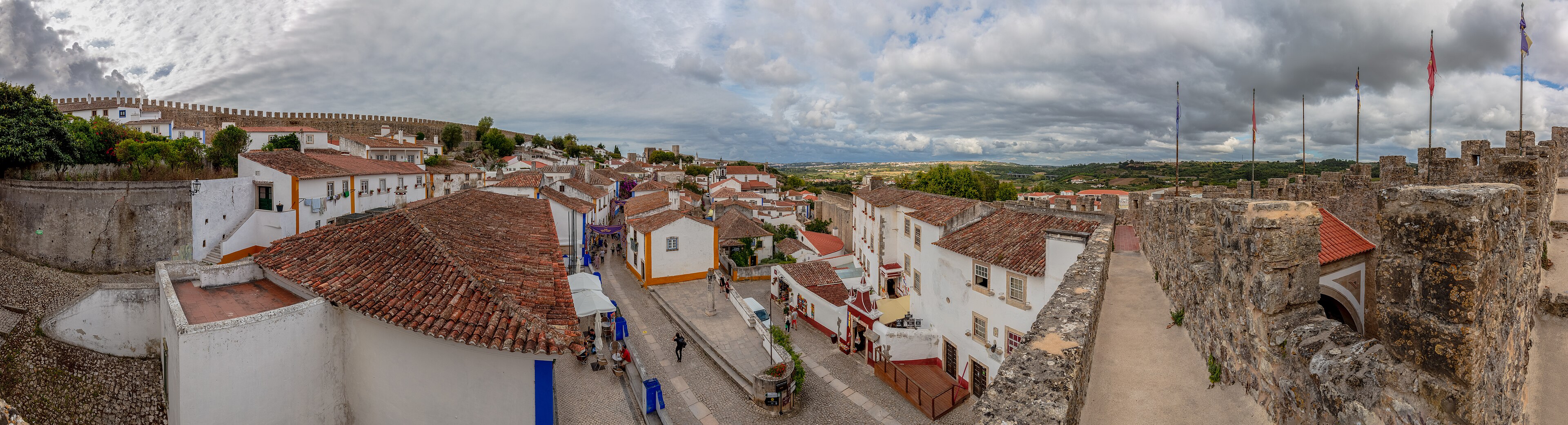
Óbidos, Portugal — photograph by Diego Delso, Wikimedia Commons , licensed under CC BY-SA 4.0 .
Largo do Chiado, Lisbon — photograph by Bahnfrend, Wikimedia Commons , licensed under CC BY-SA 4.0 .
Praia de São Rafael, Albufeira — photograph by Dan Gold, Wikimedia Commons , made available under the CC0 1.0 Universal Public Domain Dedication .